

Brazil’s President Luiz Inácio Lula da Silva strongly warned that any U.S. military intervention in Venezuela would be a “humanitarian catastrophe” with global consequences. Speaking at a Mercosur summit, Lula said extra-regional military involvement in South America sets a dangerous precedent. The warning comes amid heightened tensions following a U.S. blockade of Venezuelan oil tankers. Latin American leaders including Mexico’s president called for peaceful dialogue and respect for sovereignty. They reiterated support for democracy and human rights in Venezuela while urging restraint from foreign powers that might escalate conflict in the region.
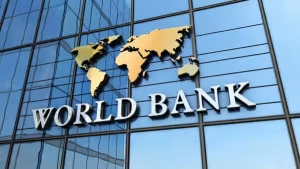 WORLD BANK APPROVES $700M FOR PAKISTAN ECONOMIC STABILITY
The World Bank approved $700 million to support Pakistan’s economy, aiming to strengthen macroeconomic stability and public services. The funding is part of a larger PRID-MPA programme, which could total around $1.35 billion over multiple phases. Of the first tranche, $600 million will support federal programs and $100 million for Sindh province. The funding follows previous grants targeting education and social services. However, Pakistan’s political tensions and structural economic issues like fragmented regulation and low investment continue to pose challenges. The support could ease regional economic friction, especially with India, which has previously expressed opposition to external financial aid for Pakistan.
 LEBANON NEARS DISARMAMENT OF HEZBOLLAH SOUTH OF LITANI
Lebanon’s government says it is close to disarming Hezbollah fighters south of the Litani River, part of a U.S-backed ceasefire deal with Israel. The effort aims to remove militia weapons and transfer control to the Lebanese army. Officials say operations will soon extend north of the Litani, though tensions remain high and both sides accuse each other of ceasefire violations. Hezbollah argues disarmament is unsafe amid continuing Israeli airstrikes. The move is seen as a key step in stabilising southern Lebanon after years of conflict but could face resistance if security deteriorates.
 CHINESE FIRMS SHIFT HEADQUARTERS TO SINGAPORE AMID GLOBAL SCRUTINY
A growing number of Chinese companies are choosing Singapore as their new headquarters, responding to increased global scrutiny and regulatory pressures. Businesses cite demand for a more stable regulatory environment, access to global financial markets, and Singapore’s strategic geopolitical location. By shifting registered headquarters, firms hope to maintain international investor confidence and navigate political tensions affecting Chinese firms worldwide. This trend highlights how geopolitical and regulatory dynamics are reshaping corporate strategies, particularly in Asia’s financial hubs. Analysts say Singapore’s pro-business policies and neutrality make it attractive as China-linked firms seek global integration amid strategic competition.
 PUTIN CALLS EU ASSET SEIZURE EFFORTS ‘ROBBERY’
Russian President Vladimir Putin criticised the European Union’s attempts to seize Russian state assets, calling them “robbery.” The EU has been considering ways to use frozen Russian assets to support Ukraine or impose penalties related to the Russia-Ukraine war. Putin’s statement reflects Moscow’s strong opposition to Western financial measures and signals Russia’s stance against broader economic sanctions. The dispute highlights deepening financial and geopolitical tension between Russia and the EU, complicating diplomatic efforts and further straining relations over the conflict in Ukraine and sanctions regimes.
 INDIA SAYS GLOBAL POWER ORDER IS CHANGING
India’s External Affairs Minister S. Jaishankar said the global power hierarchy is shifting, highlighting India’s growing role amid changing economic and demographic trends. He criticised aspects of the Western economic model, noting political and demographic challenges in developed nations. Jaishankar said India’s youthful workforce and rising capabilities position it for a more influential role in global geopolitics. His comments come as nations navigate issues of growth, technological competition, and strategic cooperation. The message reflects India’s ambition to shape global norms and influence, especially in the Indo-Pacific strategic landscape.


