

Japan and Australia agreed to expand defence cooperation, including joint exercises, intelligence sharing and technology collaboration. Leaders said the partnership supports regional stability and a free Indo-Pacific. China criticised the move, calling it part of bloc-based security politics. Tokyo and Canberra said the cooperation is defensive and transparent. The agreement reflects a broader trend of middle powers strengthening security ties amid rising uncertainty about regional power balances.
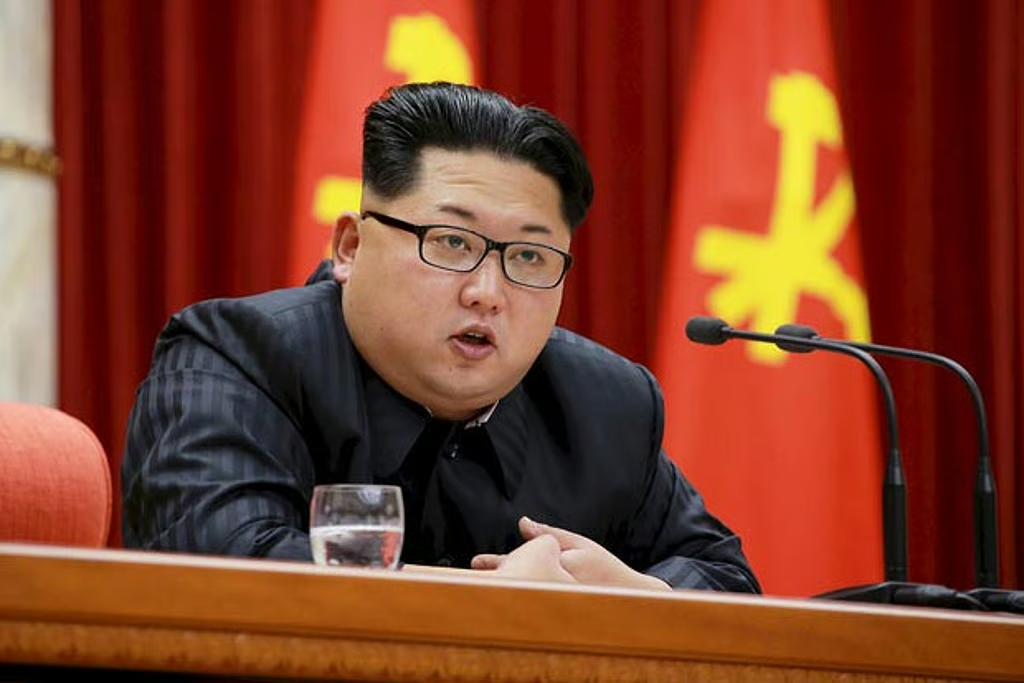
NORTH KOREA WARNS OF STRONGER RESPONSE TO US-SOUTH KOREA DRILLS
North Korea warned of a “stronger military response” after the U.S. and South Korea announced upcoming joint military exercises. Pyongyang said the drills threaten regional peace. Seoul and Washington said the exercises are defensive and necessary for deterrence. The exchange reflects ongoing tensions on the Korean Peninsula, where missile tests, military drills and sharp rhetoric remain common. The situation continues to influence security calculations in Northeast Asia.

TURKEY STEPS UP MEDIATION OFFER BETWEEN RUSSIA AND UKRAINE
Turkey renewed its offer to mediate peace talks between Russia and Ukraine, saying it maintains working relations with both sides. President Recep Tayyip Erdoğan said Ankara is ready to host negotiations and help revive stalled diplomacy. Turkey previously played a role in the Black Sea grain deal and prisoner exchanges. Analysts say Turkey’s positioning reflects its ambition to act as a regional power broker while balancing ties with NATO and Russia. While neither Moscow nor Kyiv has confirmed participation, Ankara’s move underscores growing diplomatic efforts outside Western frameworks.

CHINA SIGNALS SUPPORT FOR ASEAN CENTRALITY AMID RISING TENSIONS
China reiterated its support for ASEAN centrality in managing regional security issues, amid rising tensions in the South China Sea and Taiwan Strait. Chinese officials said disputes should be resolved through dialogue and regional mechanisms rather than external military involvement. ASEAN leaders welcomed the statement cautiously, noting the need for trust-building measures. Analysts say Beijing’s message is aimed at reassuring Southeast Asian nations while countering U.S.-led security groupings. The balance between diplomacy and power politics remains delicate in the Indo-Pacific.

FRANCE AND GERMANY PUSH FOR JOINT EU ARMS PRODUCTION
France and Germany called for expanded joint arms production within the European Union, citing lessons from the Ukraine war. Defence ministers said Europe must reduce dependence on external suppliers and improve military readiness. The proposal includes shared factories, common standards and faster procurement. Smaller EU states welcomed the idea but raised concerns about cost and national control. The move reflects Europe’s broader shift toward strategic autonomy amid uncertain global security guarantees.

LATIN AMERICA WARNS AGAINST MILITARISATION OF ENERGY POLITICS
Several Latin American governments expressed concern over the growing militarisation of energy and sanctions policy, following recent U.S. actions affecting regional oil producers. Leaders called for dialogue, respect for sovereignty and economic stability. Analysts say energy geopolitics is becoming a major fault line in the Western Hemisphere, influencing alliances and domestic politics. The statements reflect a broader push by regional powers to avoid becoming collateral damage in great-power competition.


